
Scope 3 Emissions Reduction Strategies: Proven Methods to Cut Supply Chain Carbon Impact
With scope 3 emissions representing up to 90% of companies’ total carbon footprint, implementing effective reduction strategies is essential for meeting sustainability goals. This guide explores proven methods to significantly reduce supply chain emissions through strategic mode switching, route optimisation, and fuel switching initiatives.
Strategic Framework for Scope 3 Reduction
Driving Meaningful Change: The Three Pillars of Scope 3 Emissions Reduction
In the global push towards sustainability, addressing Scope 3 emissions, those indirect emissions that occur across a company’s value chain, has emerged as both a challenge and an opportunity. Unlike direct emissions from operations (Scope 1) or purchased energy (Scope 2), Scope 3 emissions often account for the largest share of a company’s carbon footprint, sometimes representing up to 90% of total emissions. To make a tangible impact, businesses must focus on high-leverage strategies that not only reduce their environmental footprint but also enhance operational efficiency and resilience.
Three core strategies stand out for their potential to deliver significant emissions reductions
Modal optimisation, Route and Carrier optimisation, and Fuel Switching. When implemented thoughtfully, these approaches can achieve reductions of 20% to 80%, depending on the starting point, industry context, and scale of adoption.
Modal optimisation involves shifting towards transportation modes that inherently produce lower carbon emissions. For example, replacing air freight with rail or sea transport, or consolidating shipments to reduce the number of journeys, can dramatically cut emissions while often improving cost efficiency. This strategy requires a nuanced understanding of supply chain dynamics, balancing speed, reliability, and sustainability.
Route and Carrier optimisation focuses on selecting the most efficient routes and partnering with carriers that prioritise sustainability. By leveraging data analytics and real-time tracking, businesses can minimize detours, avoid congestion, and choose logistics providers with lower-emission fleets or innovative green technologies. This not only reduces emissions but can also lead to faster delivery times and lower fuel costs.
Fuel Switching is perhaps the most transformative of the three, as it involves transitioning from fossil fuels to cleaner alternatives such as biofuels, hydrogen, or electric power. Supporting the adoption of these fuels – whether through investment in infrastructure, collaboration with suppliers, or policy advocacy – can yield substantial long-term emissions reductions. However, it requires overcoming challenges such as cost, availability, and technological readiness.
Together, these strategies form a robust framework for businesses committed to reducing their Scope 3 emissions. The key to success lies in tailoring these approaches to the unique needs of each organisation, ensuring that sustainability goals align with operational realities. By focusing on these high-impact areas, companies can not only meet regulatory and stakeholder expectations but also drive innovation, resilience, and long-term value in an increasingly carbon-conscious world.
Mode Switching: Maximum Impact Strategy
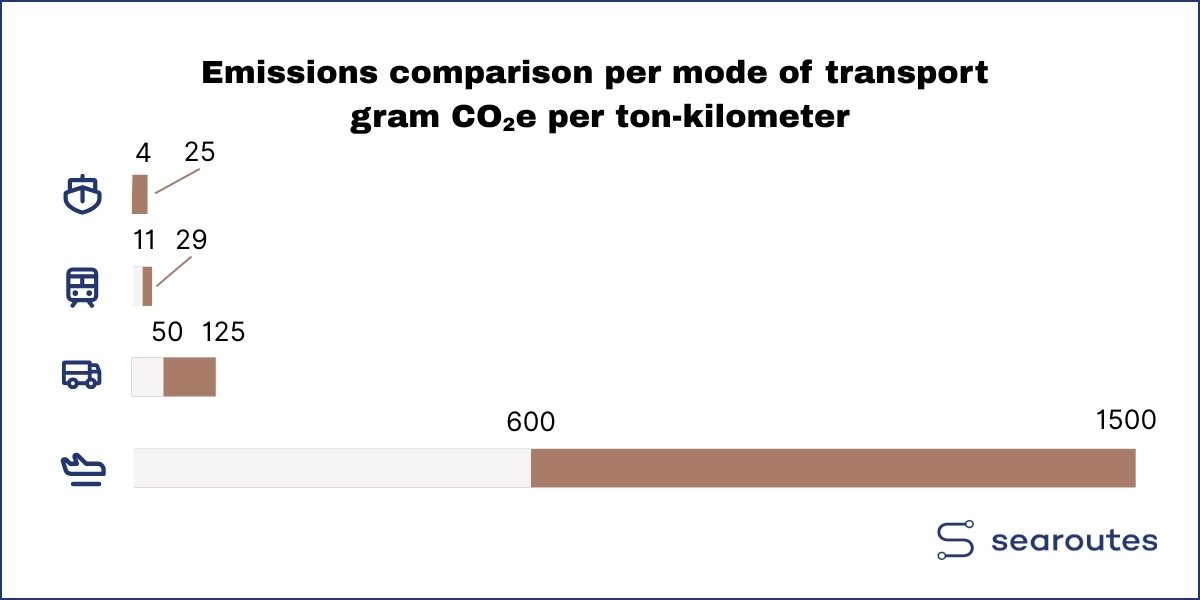
Mode switching offers the most dramatic emissions reductions by leveraging the significant carbon intensity differences between transportation modes.
Modal Carbon Intensity Comparison
Sea-Air Mode Switch Impact
Case Example: Electronics Shipment (Asia-Europe)
Example based on our shipment API from Shanghai to Hamburg
- Sea : 888 kg CO2 per TEU
- Air : 67,779 kg CO2 per TEU
Reduction : 98.69 % – Trade-off: Extended transit time (3 days to 35 days)
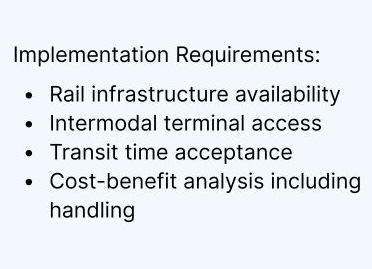
Road-Rail Modal Shift
European Overland Transport example for Hamburg, Germany-Milano, Italy
- Road Transport: 1,110 km =1,377,102g CO2e per TEU
- Rail Transport: Same route distance 1,081 km = 188,099 g CO2e per TEU
Carbon Reduction: 86% reduction
Short Sea Shipping
UK-Continental Europe Example:
- Road + Ferry: 750km = 150kg CO2e per ton
- Direct Short Sea: Same route = 45kg CO2e per ton
Carbon Reduction: 70% reduction
Multimodal optimisation – Best Practice Combination (Asia-Europe):
- Sea freight for main haul (Asia to European port)
- Rail transport for inland distribution
- Result: 85% lower emissions than air freight
Route optimisation Through Carrier Selection
Strategic carrier and route selection delivers significant reductions while maintaining service quality. We provide here a series of examples from our calculations to illustrate the importance of granular data
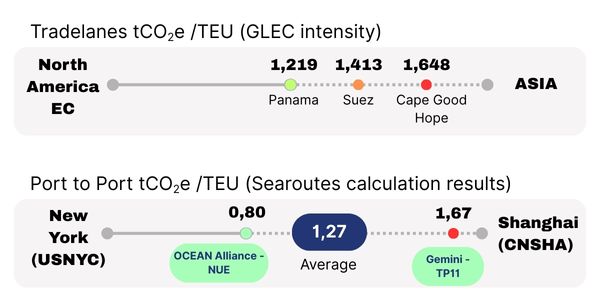
Carrier Performance Variations
Trade-lane GLEC Framework end-user emissions intensity for a dry 20 P container:
Vessel-Specific Efficiency
Container Ship Comparison (Shanghai-Rotterdam):
- Ultra Large Container Vessel: 6.8g CO2e per ton-km
- Large Container Ship: 11.4gCO2e per ton-km
- Feeder Vessel: 18.7gCO2e per ton-km
Efficiency Range: 175% difference between options
Service Selection Impact
Slower Sailing speed Benefits: Reducing speed by even a few knots can significantly cut fuel consumption and emissions. For example, reducing speed from 21.5 knots to 18–19.5 knots can improve CII ratings and ensure compliance with IMO standards until 2030. Studies show that slow steaming can achieve fuel savings of up to 31.5% at 38% main engine load, directly translating to lower CO2e emissions. The savings varies from 10 to 30% depending on the vessel type, route, and speed reduction.
Port and Route Selection
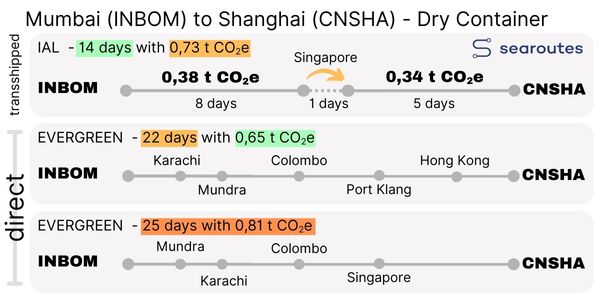
Is a direct route more efficient than a transshipment one? While direct is more efficient, actually choosing voluntarily the greenest service is offering the best option, as an illustration, here is an example of shipment options between Mumbai and Shanghai using Direct or Transshipped.
One can easily see that it is not only a question of direct versus transshiped shipment impact but global efficiency of the route.
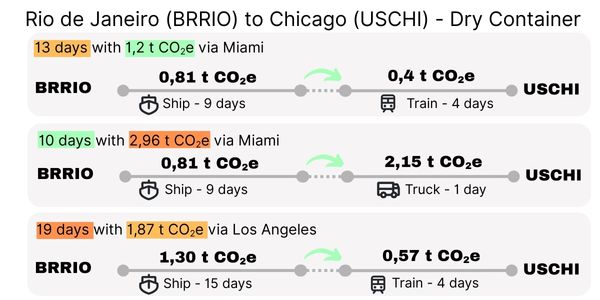
Gateway Optimisation: Here we wish to point out the influence of the port of entry when attempting to deliver inland. For that purpose; we are comparing to route delivery to Chicago, coming from South America.
Load Optimisation
According to our partner Alpha Augmented – Specialist in Load optimisation in Containers, one can reach 20% savings from load optimisation, we are their supplier for CO2 emissions calculations in transportation.
Fuel Switching Strategies
Fuel switching represents crucial long-term emissions reduction, requiring carrier collaboration and infrastructure development.
Maritime Alternative Fuels
Methanol-Powered Vessels:
- MDO = 3.87 gCO2e per g of fuel
- Methanol = 2 gCO2e per g of fuel
- Potential Reduction: 48% with renewable methanol
Check our article on biofuel to know more.
Future Maritime Fuels
Next-Generation Options:
- Green Ammonia: Near-zero emissions with renewable production
- Green Hydrogen: Zero direct emissions, new vessel technology required
- Commercial Timeline: 2030-2035 availability
- Current Status: Pilot projects and demonstrations
Road Transport Alternatives
Electric Vehicle Deployment:
- Diesel Truck: 850g CO2 per ton-km
- Electric Truck: 170g CO2 per ton-km (clean grid)
- Potential Reduction: 80% with renewable electricity
- Current Limitations: Range constraints for long-haul
Advanced Road Fuels:
- Conventional Diesel : 3.87gCO2e/g fuel
- Biodiesel (soybean): 1.17 gCO2e/g fuel
- Carbon Reduction: 70% per g fuel,
- Availability: Options available today at premium costs
Aviation Sustainable Fuels
Sustainable Aviation Fuel (SAF):
- Conventional Jet Fuel: 3,84 gCO2e/g fuel
- SAF Blend (50% Rape Seed 50% cooking oil ): 1,31 gCO2e/g fuel
- Potential Reduction 66% of emissions
- Challenge: Limited production and high costs
Implementation Framework
Implementation Framework
Organisations benefit from adopting a phased approach to emissions reduction. Quick and lasting wins include carrier benchmarking and selection improvements, service optimisation through eco-services and direct routes, enhanced load consolidation, and route optimisation with existing carrier partners.
Strategic longer-term changes involving mode switching for appropriate trade lanes, establishing long-term carrier partnerships with sustainability commitments, redesigning supply chains to enable efficient transport modes, and launching biofuel pilot programs with progressive carriers.
Transformation encompasses complete supply chain carbon optimisation, supporting alternative fuel infrastructure development, adopting advanced technologies like electric vehicles and hybrid vessels, and integrating circular economy principles throughout operations.
Performance Measurement
Companies should track absolute emissions reduction year-over-year as their primary indicator, while monitoring modal split evolution to understand the percentage shifts between transportation modes. Carrier emission intensity performance provides insights into partner selection effectiveness, and alternative fuel adoption percentages demonstrate progress toward cleaner energy transitions.
Technology tools supporting these measurements include real-time emissions tracking platforms that integrate vessel performance monitoring via AIS data. Route optimisation systems incorporate carbon calculations directly into decision-making processes, while supplier sustainability scorecards provide comprehensive partner assessment capabilities.
Technology Enablers
Digital optimisation
Route planning systems now integrate carbon optimisation alongside traditional cost and time factors. These platforms combine real-time weather data, traffic congestion information, and multi-modal optimisation algorithms to identify the lowest-emission routing options. Predictive analytics enhance capacity utilisation by forecasting demand patterns and enabling better consolidation opportunities.
Monitoring and Tracking
IoT-enabled sensors provide continuous fuel consumption monitoring across vessel and vehicle fleets, while blockchain technology ensures transparent and immutable supply chain emissions records. Real-time performance benchmarking allows companies to compare actual emissions against targets, with automated calculation and reporting systems reducing the administrative burden of compliance.
Future Outlook
The technology roadmap for 2025-2030 includes commercial deployment of green ammonia and hydrogen vessels, alongside significant expansion of electric truck infrastructure for medium-haul applications. Advanced biofuel production continues scaling up while costs decrease, and autonomous vessel operations promise additional efficiency improvements through optimised routing and fuel management.
Policy drivers are accelerating adoption through International Maritime Organisation emissions regulations and regional carbon pricing mechanisms. Infrastructure investments in clean fuel production and distribution networks, combined with sustainability-linked financing incentives, create favorable conditions for widespread adoption of low-carbon transport solutions.
Conclusion
Achieving significant scope 3 emissions reduction requires combining immediate operational improvements with long-term strategic transformation.
The most effective approach integrates mode switching, route optimisation, and fuel switching strategies tailored to specific supply chain requirements.
Success depends on taking action now while building capabilities for future transformation. Companies that implement comprehensive reduction strategies will achieve their sustainability goals while building competitive advantages through more efficient, resilient operations.
The technologies and partnerships needed for transformation are available today. Start by assessing your transportation portfolio, engaging progressive carriers, and implementing measurement systems that enable continuous improvement toward your scope 3 reduction targets.
Searoutes has developed a solution to enable your carbon conscious decision making: Freight Emissions Optimizer. It provides all data required to make your transportation choices, based on your past data and future services availability.
Contact Searoutes today to learn how our Freight Emissions solutions can transform your supply chain sustainability efforts.